So this week's assignment is all about artists who broke the 'rules'. 'Rules' in this context refers to what society deemed appropriate in the art scene during a certain era/time period. The three artists whom i have chosen to blog about blatantly ignored these rules and received a lot of shade from art critics and enthusiasts. But with changing times, people took a step back and realised that these artists were in fact ahead of their time and were creative geniuses in their own right.
So here goes,
PABLO PICASSO

This insanely famous Spanish artist is widely credited for the invention of the painting technique referred to as 'CUBISM'. Cubsim incorporates the use of geometric forms such that the viewer feels like he/she is looking at the two dimentional painting from every angle, thus making the subject seem three dimensional. Picasso first exhibited this technique in a painting of 5 woman who looked distorted and disproportionate. He had tried to paint them from more than one angle at a time.
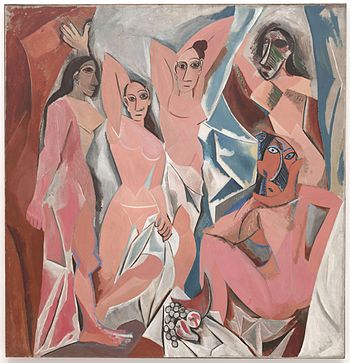 |
Les Demoiselles D’Avignon |
The public did not take too kindly to his representation of the female body. In an age when portraits and landscapes were what society considered tasteful, this was almost an insult to their ideologies and beliefs. They were highly critical of Picasso and claimed that he was making a mockery of art itself. This opinion of his art persisted well into the 20th century till abstracts came into being. At this point, people realised that Picasso's painting was in fact a stroke of genius. In this way, Picasso paved the way for abstraction in art which he will always be remembered for.


M. F. HUSSAIN

Maqbool Fida Hussain, a Muslim painter born in India was famous for his paintings of Hindu Gods and Goddesses. His paintings were quite controversial as he saw the Gods and Goddesses as 'visual stimuli instead of deities'. As a result, his work would often incorporate them nude and in suggestive poses. He meant for his paintings to portray the beauty and sensuality of Hindu Goddesses, but orthodox Hindus did not appreciate their deities being represented like that.
He was victim to a lot of criticism and hate. A magazine published one of his paintings and called him a 'butcher' of religion. Further more, being Muslim did not help his case. People believed that he did not have the right to paint Gods of another religion as he pleased. He was later banished from the country and he migrated to Bangladesh where he continued to paint. He died in 2011 at the age of 95. Even though some people are still of the opinion that his motives were impure, there are many who realised what his true mission was.
Hussain also loved to paint horses as they were the ideal representation of strength, beauty and grace. I have personally visited Mr. Hussain at one of his galleries in Chennai and I was in awe of his work. He inspired me so much and my own art is majorly inspired by his strokes and lines.
VINCENT VAN GOGH

Van Gogh was a Dutch painter who has been regarded as one of the most famous painters of all time. But this wasn't the case when he was alive. In a time when impressionism was everything, his paintings attracted little or no attention due to their somber tones. As a person, Van Gogh was very contained, so he always found it hard to express himself through his paintings. He always used earthy and deep colours which were not what society appreciated. Some of his most famous paintings are 'The Sunflower', 'The Scream', his self potraits before and after he chopped off his ear lobe and of course 'Starry Night'. Starry Night really shows off Van Gogh's unique strokes that are curved and 'swirly'. It is a true masterpiece.
After Van Gogh died, his works became hugely famous and people began to understand and relate to his paintings which brought him up to the status he withholds today in the art world.
Thank you,
Samyuktha Chandar
Bibliography:
http://www.vangoghgallery.com/misc/overview.html
http://en.wikipedia.org/wiki/M._F._Husain
http://www.teenink.com/nonfiction/academic/article/306756/A-Retrospect-of-How-Pablo-Picasso-Changed-the-World/

No comments:
Post a Comment